Why Coquina Key's Waterfront Condos Are Priced Below the Rest of St. Petersburg
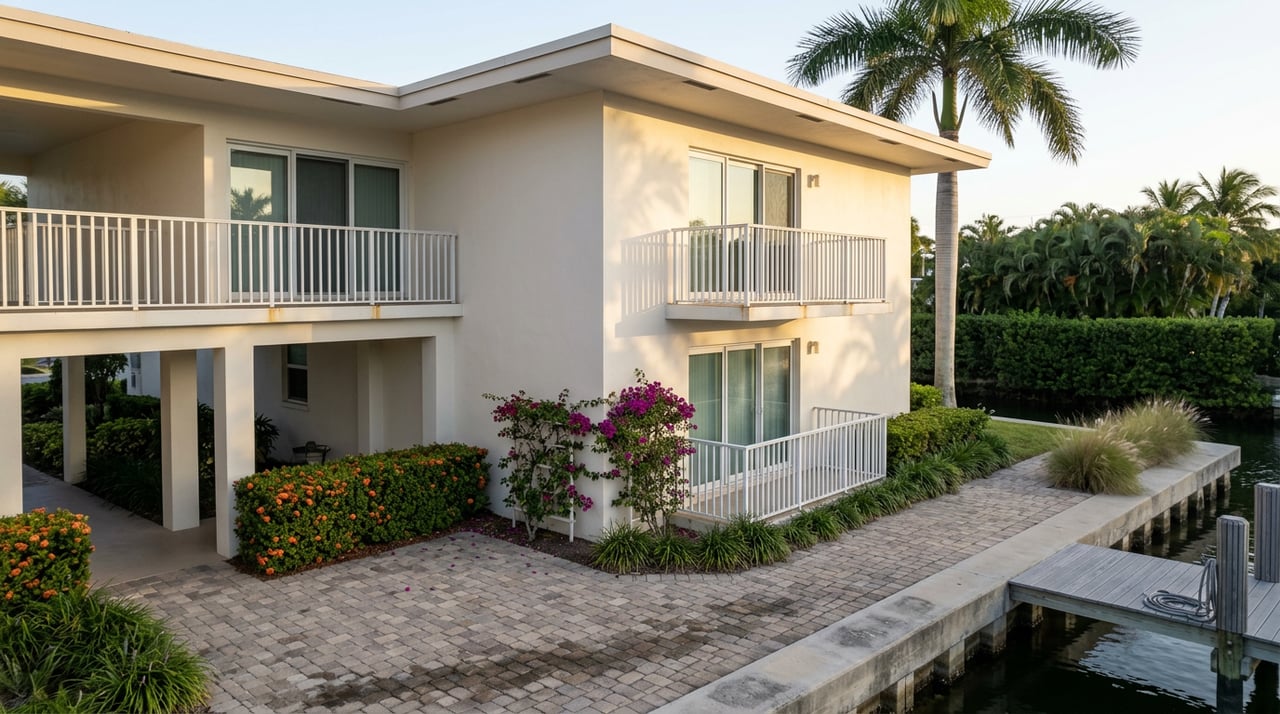
Scroll listings on Coquina Key long enough and you'll notice something that doesn't add up. A two-bedroom condo at Waterside at Coquina Key South lists in the high $200,000s. A few blocks away, a townhome in the same neighborhood, same waterfront access, similar square footage, carries a price tag that looks almost identical on paper. They read like the same purchase. They are not, and the difference has nothing to do with the view.
As of mid-August 2026, active listings across Waterside at Coquina Key carry a median list price of $269,950 and average $355 per square foot. Look at the South village specifically, and its average runs closer to $287 per square foot, against a St. Petersburg citywide condo average of $370 per square foot and a Pinellas County average of $379. That's not a rounding error. It's an $80 to $90 gap on every square foot, sitting inside one of the largest waterfront communities on the island.
Buyers scanning median prices assume that gap reflects something about Coquina Key itself, maybe distance from downtown, maybe the age of the buildings. It doesn't. It reflects a financing and reserve-funding mechanism that took full effect on January 1, 2026, and it applies unevenly to the different ways you can own waterfront property on this island.
Florida's condo reforms trace back to the Champlain Towers South collapse in 2021. Senate Bill 4-D, followed by Senate Bill 154 and House Bill 913, built a two-part compliance system for any residential condominium building three stories or taller: a milestone structural inspection once the building reaches 25 or 30 years old, and a Structural Integrity Reserve Study, or SIRS, that forces the association to actually fund repairs for eight structural components rather than voting to defer them.
That second part is what changed the math for buyers. For decades, Florida condo boards could vote to waive or underfund reserves, which kept monthly dues artificially low and kicked the real cost down the road. As of January 1, 2026, that option is gone for roofs, load-bearing walls, fire protection, plumbing, electrical systems, waterproofing, windows and exterior doors, and any other structural item with a deferred cost above the statutory threshold. Associations either had the money saved already or they're raising it now, all at once, through special assessments or steep dues increases.
Tampa Bay has absorbed more of this than almost any other metro in the country. As of May 2026, HOA fees across the Tampa-St. Petersburg region had risen 17.2% year over year, the steepest jump of any major metro in the country. At the same point, more than 1,400 Florida condo buildings sat on Fannie Mae's restricted list, which means conventional financing wasn't available to buyers at all. Those buildings end up requiring portfolio loans or non-QM financing, usually at a higher rate, which thins the pool of buyers who can even make an offer.
Waterside at Coquina Key South didn't need to wait for the 2026 deadline to feel this. In 2023, the association's board proposed a special assessment after its property insurance premium jumped 300%, combined with what the association's own report described as little to no cash reserves on hand. Owners circulated a petition asking the board to spread that cost through a one-time special assessment covering roughly $1.5 million in insurance and reserve needs, rather than absorb it through a 36% increase to monthly dues. The petition cited plans to reduce future premiums through completed roof work, wind mitigation certification, and a higher building deductible, but the underlying problem was the same one the state legislature would later force every association to confront: reserves that hadn't kept pace with what the buildings actually needed.
That history doesn't disappear when a listing agent photographs a renovated kitchen. It shows up in the association's financials, and increasingly, it shows up in the price per square foot, because buyers and their lenders are pricing in the risk of a special assessment before they price in the granite countertops.
Waterside spans 918 condos across its North and South villages. In the South village alone, most of the 625 units run two-bedroom, two-bath layouts between roughly 700 and 1,400 square feet, with amenities that include a private residents-only restaurant at the Waterside Yacht Club, tennis courts, multiple pools, and a marina with individually owned boat slips. None of that changes because a building's reserve study came back showing a funding gap. What changes is the price a buyer is willing to pay once that gap is visible, and whether a lender is willing to write a conventional loan against it at all.
This is where treating Coquina Key as a single market misleads a buyer. The island holds three genuinely different ownership structures, and only one of them carries the SIRS mechanism.
| Product type | What determines SIRS/milestone applicability | Applies? | What actually drives price risk |
|---|---|---|---|
| Waterside condos (multi-story buildings) | Condominium buildings 3+ habitable stories | Yes | Reserve funding status, insurance history, Fannie Mae warrantability |
| Coquina Key Townhomes | Low-rise, single-unit attached buildings under 3 stories | No | Standard HOA dues and association financial health |
| Single-family waterfront homes | Not a condominium or cooperative at all | No | Individual seawall and dock condition, owner-funded maintenance |
Coquina Key Townhomes, a 136-unit gated community built as 94 separate single-unit buildings, never triggers a milestone inspection or a SIRS, because Florida's law only reaches condominium and cooperative buildings that are three or more habitable stories tall. Low-rise, single-unit attached housing falls outside that threshold no matter how old the buildings get. A buyer comparing a Waterside condo to a Coquina Key Townhome unit at a similar price point isn't comparing two versions of the same risk. One sits inside a state-mandated reserve study and a possible non-warrantable financing flag. The other, by the plain terms of the statute, does not.
Single-family waterfront homes sit outside this entirely. As of June 2026, Coquina Key's waterfront single-family stock had a median listing price of $340,000 across 38 active listings, and the cost exposure there runs through the seawall and dock rather than a condo association's books. Homeowners in the St. Petersburg area have reported seawall replacement costs in the range of $350 to $500 per linear foot, which for a typical residential lot puts a full seawall rebuild in the tens of thousands of dollars, an expense that belongs entirely to the owner rather than to a shared reserve fund.
If you're comparing a Waterside unit to other waterfront options on the island, the list price and the price per square foot aren't the whole story. Before writing an offer, ask for the SIRS report and the most recent milestone inspection status, if the building qualifies. Ask for the last twelve months of board meeting minutes for any mention of a pending or discussed special assessment. Ask what the master insurance policy actually covers and whether the building appears on Fannie Mae's condo project list, since that single flag determines whether you're financing with a standard mortgage or a more expensive alternative.
None of this means avoiding Waterside or condo ownership on Coquina Key. Many buildings are fully compliant, with milestone inspections completed, SIRS studies current, and reserves funded at healthy levels. It means the lower price per square foot you're seeing isn't automatically a bargain. It's a number that reflects how much financial homework the association has already done, and how much of that work might still land on the next owner.
Does the SIRS law apply to every building at Waterside at Coquina Key? It applies to any residential condominium building on the property that's three or more habitable stories tall. Lower buildings within the same complex may not trigger the requirement, so the applicable status can differ building to building even within one community.
Are Coquina Key Townhomes a safer purchase because they skip the SIRS requirement? Safer isn't the right frame. They simply carry a different type of financial exposure, standard HOA dues and association reserve health, rather than the state-mandated structural reserve study that applies to taller condominium buildings. Either structure can be well run or poorly run. The law that governs them is just different because of building height, not because one type of ownership is inherently sounder than the other.
Will the price gap between Waterside and the broader St. Petersburg condo market close over time? As more associations complete their SIRS studies and reach full reserve funding, buildings with clean compliance records and healthy reserves tend to trade closer to the broader market average, while buildings still working through deferred maintenance or financing restrictions tend to lag. The gap is a function of where a given building sits in that compliance process, not a permanent feature of the neighborhood.
Coquina Key still delivers what draws people to it in the first place, water on nearly every street and a shorter drive to downtown than most of the barrier islands offer. Understanding why two listings with similar price tags carry different risk is what lets you actually compare them. If you're weighing a waterfront condo against a townhome or a single-family lot on the island and want the specific documents to request before you write an offer, Homes by Nanette can walk through what each building's reserve and inspection status actually means for your financing and your long-term costs. Let's Connect.
Stay up to date on the latest real estate trends.

Looking to buy, sell, or just have a question? I'm always available to help and would love to work with you. Contact me today to start your home searching journey!

NANETTE COUNSELMAN
4293 Pompano Dr SE St. Petersburg FL 33705